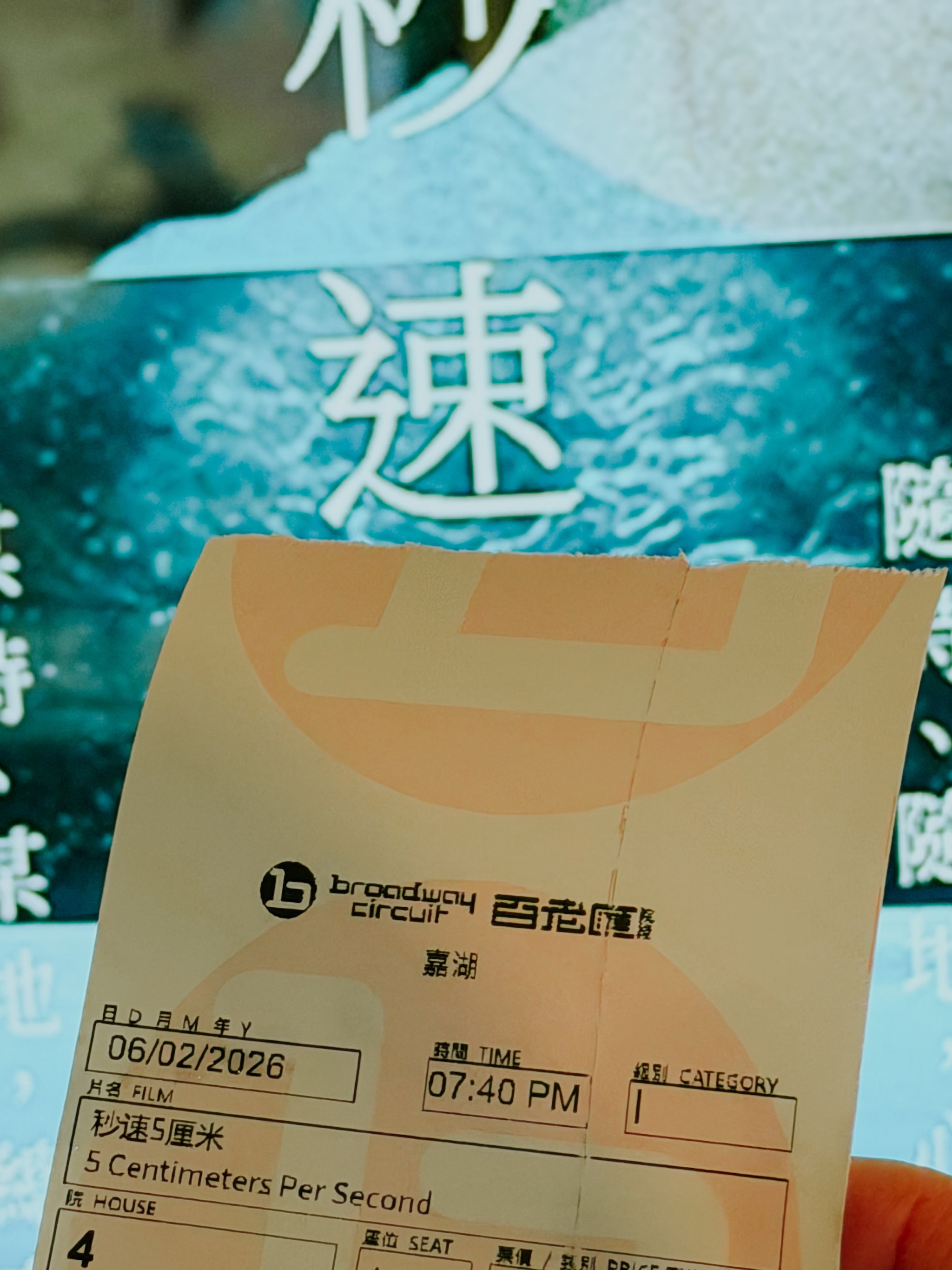
Despite my unhealthy rewatch count for 5 Centimeters per Second, I find it a difficult recommendation, primarily due to the utter lack of conventional drama. There is no confrontation, no villain, no reckoning, just a linear collage of mundane events driven by unavoidable departures and unspoken feelings that are arguably lamentable, but in no way tragic. One is left to decide whether this restraint is the point — the capacity of the everyday to wound — or a limitation of the storytelling itself.
There is a serendipitous symmetry in having first watched the anime at the protagonists’ age at the story’s beginning, and now rewatching this adaptation at their age at the end. I couldn’t help but wonder what I had felt watching the original anime in my early teens, and why I was so impressed that I felt almost compelled to go see this adaptation. Remember I could not. Maybe it’s just rose-colored nostalgia. Or maybe, as the protagonist herself suggests, that’s the formative residue of an early age at work.
The adaptation expands and rearranges the original material with mixed results. Some additions feel thin, and the newly introduced coincidences strain credibility more than they enrich the narrative. The story may simply be too spare to bear expansion. Yet the reconstructed scenes still evoke the memory of watching and rewatching the same file on a portable player, a video that once took hours to download and felt worth every minute of waiting.